
Liverpool Boys and Girls School HS Phases 3 – 9
MBM Project Lead
Client Name
School Infrastructure NSW
Sector
Timeline
2024- 2028
Project Value
Confidential
MBM Project Team
- David Madden – Founding Director
- Sophie Chen – Executive Quantity Surveyor
- Emily Wang – Senior Quantity Surveyor
Services Provided
MBM is engaged to provide full quantity surveying services for Phase 3-9, including cost planning in Schematic Design, Pre-Tender Estimate, Tender Review, Detailed Design, monthly cashflow and cost reporting, and Post Contract services such as progress claims and variation assessments.
Since MBM’s involvement within the project in Schematic Design phase, MBM have been working closely with the design team and project team to explore different stacking options, and area optimisation to assist SINSW to realise the maximum delivered scopes under a fixed budget.
Project Background and Scope
The proposed development for Liverpool Boys and Girls High School is to meet SINSW’s objectives to deliver the capital works program for the NSW Department of Education.
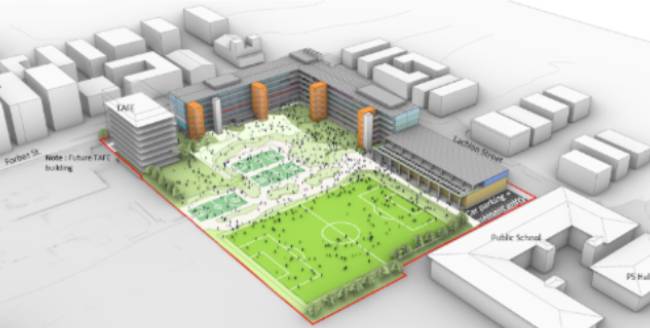
The project will be delivering a new co-educational High School on existing Liverpool Boys High School site for a school capacity of 2,000 students with full Stream 12 scope including 103 teaching spaces plus 7 teaching spaces, library, hall, canteen, administration, play space, carparking etc.
The site is in a prominent location to Liverpool Hospital and Liverpool CBD and has a low flood risk towards the East.
Liverpool Boys and Girls HS will be an urban school on a 6-storey design, with 5 star Green Star Certification and to be conventionally built. The school will be open on Day 1, Term 1 2028.
A temporary Boys school will be constructed as the new school will be built on existing Liverpool Boys High School site.
The project is based on the Design and Construct procurement model to be tendered at end of Schematic Design.
Project Challenges
- Height of the building
Delivering a 6-storey vertical school presents key challenges for cost managers, including higher structural, services, and fire safety costs, complex access and compliance requirements, limited site efficiency, and increased preliminaries. Limited benchmarks and stakeholder-driven changes for vertical schools also pose a challenge to the project.
- Pattern book
One key challenge for the cost manager is adapting the standardized “pattern book” design to suit a complex 6-storey vertical school. While pattern books promote efficiency and consistency, they are often based on low-rise layouts, making them less suited to constrained urban sites or multi-level configurations. This results in design modifications, compliance issues, and potential cost overruns, requiring careful cost planning, risk allowances, and close coordination with the design team.
- Size of the contract
Managing the $240 million project budget is major challenge, requiring strict cost control across all phases to ensure value for money. High construction costs driven by vertical design, complex services, and urban site constraints demand accurate forecasting, early risk identification, and proactive cost management. Any scope changes, design variations, or market fluctuations must be thoroughly assessed to avoid exceeding the allocated funding.
- Hall & teaching space
Connecting the hall to teaching spaces in a vertical school design poses a cost challenge, as it often requires additional structural elements, circulation zones, and acoustic treatments to ensure smooth, functional integration. Managing these requirements within the budget demands careful coordination with the design team to optimize layout efficiency while controlling construction and fit-out costs.
- Sharing land with Public School
Sharing land with Gulyangarri Public School presents a challenge due to the need for careful coordination of construction activities to minimize disruption to the existing school’s operations. This can increase costs related to restricted site access, temporary safety measures, and staged works. Managing these complexities requires detailed planning and sufficient contingency allowances to maintain budget discipline while ensuring safe and functional environments for both schools.
- Temporary school
The requirement for a temporary school during construction presents a significant challenge, introducing additional costs for setup, relocation, services, and compliance, all of which must be accounted for within the overall budget. Managing these costs while ensuring minimal disruption to school operations requires detailed planning, staging coordination, and appropriate risk allowances—particularly if temporary facilities are needed for an extended period and must meet full educational and safety standards.
MBM Solutions
- Proactively managing the budget
MBM promotes a “design-to-cost” approach rather than simply “costing a design.” We have provided innovative solutions throughout the design development process, applying early and detailed cost planning with allowances for vertical build premiums such as lifts, fire systems, and structural enhancements. We build in robust contingencies and closely coordinate with the design team to manage services integration and spatial efficiency. We also proactively manage risks, provide design options, and deliver accurate cost reporting to advise budget position and to help control scope creep.
- Pattern book modification
As the cost manager leading the development of the Pattern Book, we work closely with the design team to adapt pattern book templates efficiently, applying value engineering to tailor standardized designs for vertical school configurations while minimizing additional costs.
- Temporary School Allowance
We provided strategic cost advice on the scope and configuration of the temporary school to support the major project delivery. Our input ensured the temporary school works were planned efficiently, minimising abortive works and reducing re-work during transition to the permanent school. By aligning the temporary school scope with full project requirements, we helped streamline construction sequencing, optimise expenditure, and deliver better value for the client.
- Cost Reporting & Collaboration
MBM maintains close communication with the design team, School Infrastructure NSW, and the project manager to manage and report on project costs. This includes monitoring risks, reviewing cost updates, and ensuring the project remains financially on track.